

The useful question is not “Which model is better?” It is “What are we missing: an individual capability, coordinated team capacity, or a clearly bounded deliverable?”
If your internal team already has the leadership and working system to deliver, an embedded senior engineer may fill a specific gap. If the work needs several roles to move together over an evolving backlog, a dedicated engineering squad may be worth evaluating. If the outcome is bounded and acceptance criteria can be agreed, a scoped delivery project belongs in the comparison too.
Start with the work and its owners. Choose the smallest team shape that can move it forward without leaving essential responsibilities unassigned.
First, separate three decisions
Team shape, delivery responsibility and billing are different choices.
- Team shape: one embedded engineer, several individually integrated specialists, or a coordinated squad/pod.
- Delivery responsibility: who prioritizes work, makes technical decisions, coordinates dependencies, reviews quality and authorizes release.
- Commercial structure: how capacity or deliverables are priced and how changes are agreed.
A monthly invoice does not, by itself, make an engagement a managed team. A squad is not automatically a fixed-price project. An embedded engineer can still receive operating support from the provider. Ask what each proposal includes rather than inferring responsibility from its label.
What staff augmentation and a dedicated team mean here
Staff augmentation means adding people to an existing client team and working system. An embedded senior engineer is one possible form of it, not necessarily a third, unrelated delivery model. In this comparison, the client has the backlog, technical leadership and coordination capacity needed to direct the additional engineer's work. Any extra provider responsibilities should be explicit.
A dedicated team or engineering squad means a coordinated group assembled around a workstream or backlog. Its roles and coordination arrangements are agreed together. Product priorities, architecture, acceptance and release authority still need named owners; “dedicated” does not mean the client gives up control or that the provider takes every responsibility.
A scoped delivery project is organized around a defined outcome and acceptance boundary. Team composition may vary. It is useful to compare this option when the problem is more specific than an ongoing capacity gap.
These are working definitions for this guide. Vendors may use the same words for different services. Compare the operating details.
Compare the working model, not just the headcount
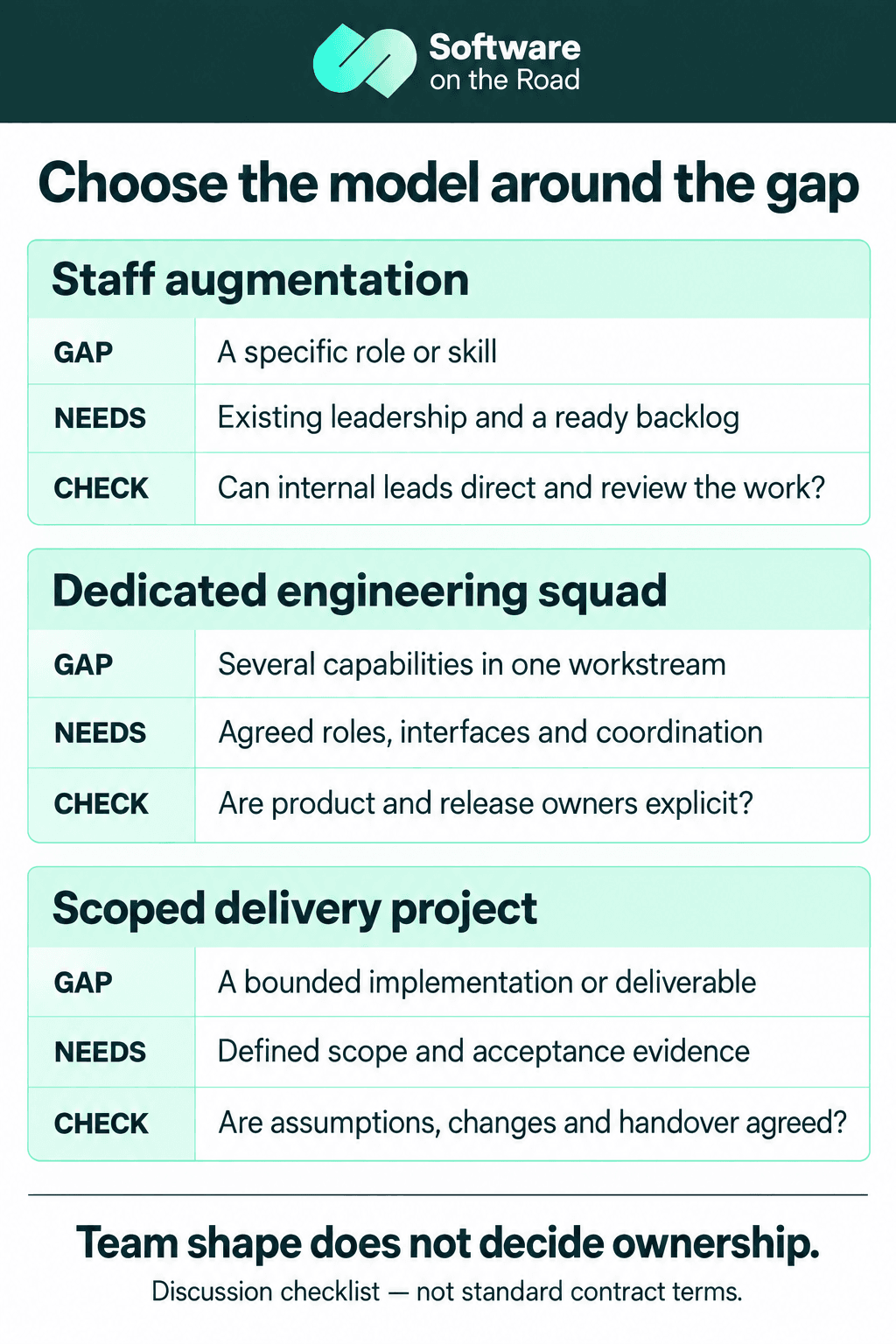
| Decision | Staff augmentation / embedded engineer | Dedicated engineering squad | Scoped delivery project |
|---|---|---|---|
| Problem to evaluate | A role or skill gap within an existing team | A workstream needing several coordinated capabilities | A bounded implementation or deliverable |
| Internal direction | Identify the client lead who can direct and review the engineer's work | Agree product ownership, technical leadership and day-to-day coordination | Agree who defines requirements and accepts the deliverable |
| Coordination | Check whether the existing team can absorb another contributor | Specify coordination support, interfaces and escalation owners | Specify milestones, dependencies and change handling |
| Onboarding | Role-specific access, context and team integration | Role-specific onboarding plus team interfaces and shared context | Access and context needed for the agreed scope |
| Quality and release | Assign review, testing and release authority explicitly | Assign them explicitly; team shape alone does not decide ownership | Define acceptance evidence and release/handover responsibility |
| Continuity | Plan coverage and knowledge transfer for the added role | Plan continuity across roles without assuming everyone knows everything | Plan support and handover after acceptance |
| Cost comparison | Include the internal effort to lead and enable the engineer | Check which coordination roles/support are included, optional or excluded | Check scope assumptions, exclusions and change terms |
| Warning sign | A person is being hired to compensate for missing leadership or an unclear backlog | A larger team is proposed before there is enough ready work or clear ownership | “Fixed scope” is being used for a problem whose boundaries are still unknown |
The table is a discussion checklist, not a universal allocation of responsibilities or a statement of standard SOTR contract terms.
When an embedded senior engineer is a sensible starting point
Consider the individual model when you can explain the missing capability and where it fits. For example, your team may have a clear backlog and review process but need additional backend, platform or reliability expertise.
Before committing, name the person who will prioritize that engineer's work and answer domain questions. Check whether code review, testing and release support already exist. The new engineer should not discover after kickoff that they are also expected to be the unplanned product owner, architect and delivery manager.
Do not choose this model solely because one person is easier to approve. If the work actually needs several capabilities and nobody can coordinate them, the smaller engagement may leave the underlying delivery gap unresolved.
When a dedicated squad is worth evaluating
Consider a squad when a coherent workstream needs multiple capabilities to collaborate over time. Examples might involve product changes that depend on backend work, platform changes and testing, rather than a queue of interchangeable tickets.
Define the workstream boundary first. Which systems can the squad change? Which other teams does it depend on? Who resolves competing priorities? Who reviews architecture and accepts releases? Then decide which roles need sustained capacity and which can contribute periodically.
“Dedicated” should not become shorthand for “as many engineers as possible.” A smaller coordinated team may be appropriate for one workstream, while several specialists embedded across existing teams may fit another. Team composition is a scoping decision, not a fixed headcount inferred from a marketing label.
Do not choose a squad to bypass product decisions that remain unmade. A team cannot remove the need for access, a usable backlog, clear ownership and acceptance criteria.
When a scoped project belongs in the comparison
A project can be a useful option when the deliverable, dependencies and acceptance evidence can be described well enough to agree a boundary. For example, a contained implementation may have a clearer finish line than an evolving product roadmap.
If the scope is uncertain, distinguish discovery from delivery. Identify the questions that must be answered before a delivery commitment can be evaluated. Do not assume a fixed-price label removes uncertainty; ask how assumptions, exclusions and changes will be handled.
Also ask what happens after acceptance. Ownership of the code, documentation, operation and future changes should not be left to the last day of the engagement.
Compare total engagement effort without inventing savings
There is no defensible universal rule that a dedicated squad is cheaper than staff augmentation, or the reverse. For your comparison, list:
- Agreed capacity or project fees, including which leadership/support roles they cover.
- Internal product, technical leadership and coordination time that remains necessary.
- Onboarding and enablement work: access, environments, domain context and review support.
- Tools or infrastructure costs that are not already covered elsewhere.
- Continuity and transition work, including knowledge transfer and any agreed support.
Use consistent assumptions and avoid counting an included service again as a separate cost. If comparable figures are unavailable, record that gap rather than turning estimates into a savings claim.
A proposal with a lower headline rate may cover a different role mix or responsibility boundary. A proposal with a delivery-management role may still need substantial client-side product direction. Neither invoice format nor a promise of speed answers the ownership question.
This guide does not publish rates, savings percentages, contractual minimums or an ROI forecast. Commercial terms belong in a scoped proposal.
Onboarding is a readiness check, not just a start date
Before kickoff, ask whether the following are ready or have an owner:
- A first workstream and a prioritized starting backlog.
- Interview and technical-fit validation for the proposed people.
- Client-approved access, device and environment requirements.
- Repository, testing and release context appropriate to the work.
- Working-hour overlap, communication channels and review cadence.
- A named product decision-maker and technical escalation owner.
- Agreed acceptance evidence, documentation and knowledge-transfer expectations.
These are buyer-side questions, not a claim that every control is already implemented by a provider. Separate the date candidates are presented from the date your environment and agreement are ready for work.
Plan continuity before adding capacity
For an individual engagement, ask who holds the context if that person is unavailable and how work will be documented. For a squad, ask how responsibilities and knowledge are distributed across roles and interfaces with other teams.
In either model, clarify how a profile change, handover or change in team size would be discussed. Do not infer a replacement deadline, free overlap period, guaranteed availability or on-call coverage from the phrase “ongoing support.” Those details require an explicit agreement.
One published SOTR example—and its limits
SOTR's published accounting-automation case describes senior engineering and DevOps/SRE contributions across product, platform, QA and accounting workflows. It is an example of work spanning several capabilities, not proof that one engagement model always outperforms another. The public summary does not establish why the client chose that model or quantify a cost or speed advantage. Read the anonymized case.
Two illustrative decisions, not client results
Scenario A: an existing product team needs a backend specialist. The team has a product owner, technical lead, review process and a ready backlog. The decision to evaluate is whether one embedded senior engineer supplies the missing capability without creating an additional coordination gap. Before hiring, validate the real work and the time existing leads can spend on integration.
Scenario B: a workstream crosses application, platform and testing boundaries. A modernization initiative has interdependent work across those areas. Evaluate whether a coordinated squad would give it a clearer working boundary, while keeping product, architecture and release owners explicit. If requirements or access are unresolved, address that readiness gap before treating additional capacity as the solution.
These scenarios illustrate the decision framework. They are not accounts of SOTR projects, customer choices or measured outcomes.
Questions to bring to a delivery discussion
- What is the first workstream, and what would accepted progress look like?
- Is the constraint an individual capability, coordination across roles, or an undefined scope?
- Who owns product priorities, technical decisions, review, testing and release?
- What can our internal leads realistically absorb?
- Which roles need ongoing involvement and which can contribute to a bounded task?
- What access, procurement or environment requirements must be resolved before kickoff?
- What is included in the proposal, and how are changes, continuity and handover handled?
Put these answers next to each proposal. If the team shapes differ, compare them against the same workstream and responsibility assumptions—not only the number of engineers or the price of an hour.
Start with the delivery need
For an ongoing engineering workstream, explore SOTR's dedicated engineering squads. Bring the backlog, current team responsibilities and the capability or coordination gap to a delivery discussion.
The goal is not to sell the largest team. It is to agree an appropriate team shape, interview the proposed people and make the path to kickoff clear.

